
Load testing of the Körös bridges
How the SURVIOT measurement system recorded the movement of the precast segments on three large Körös bridges during the load tests run by the Bridge Department of Magyar Közút.
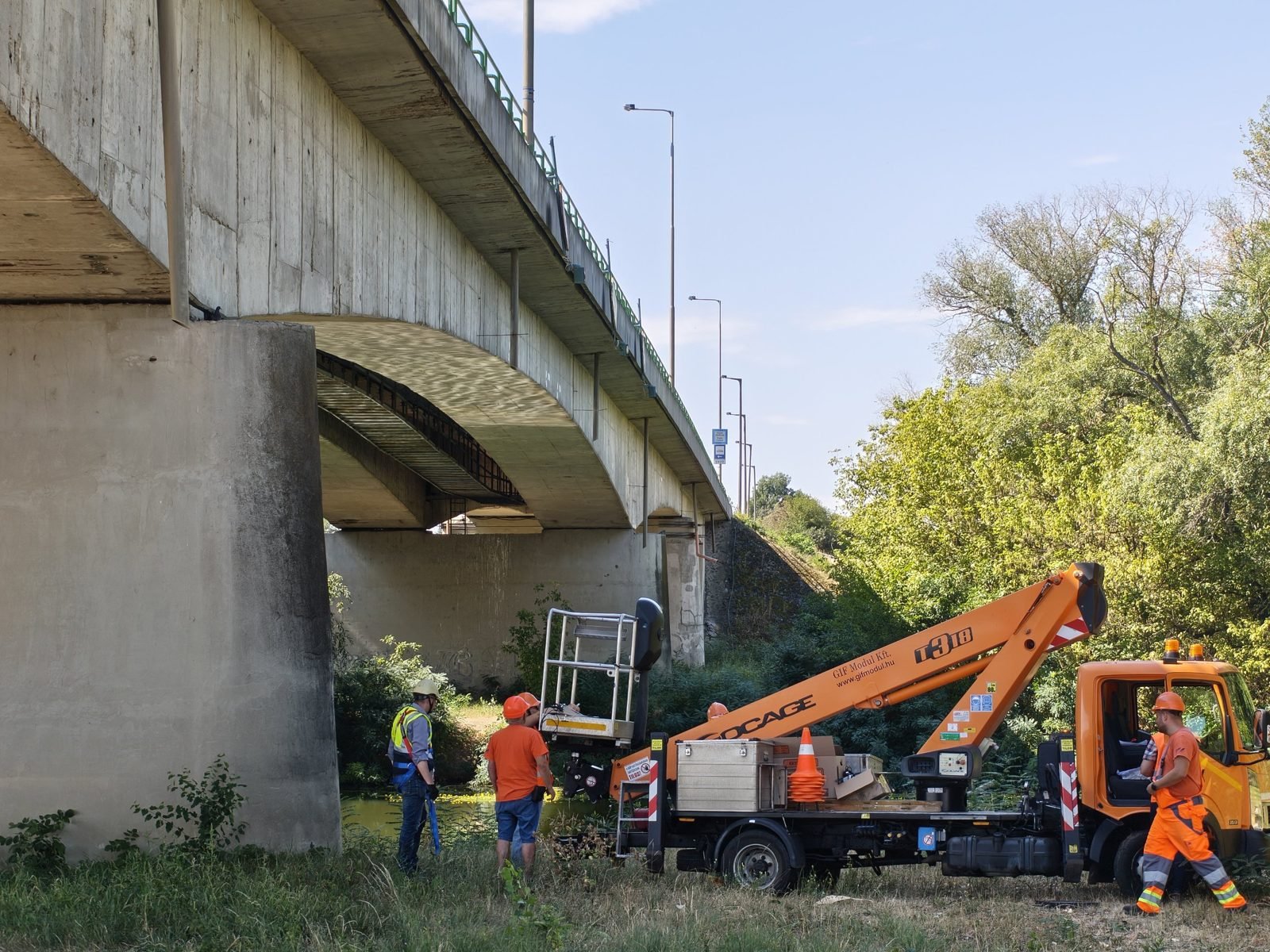
Summary
In September 2026 the Bridge Department of Magyar Közút carried out bridge inspection measurements on three large Körös bridges, at Köröstarcsa, Körösladány and Kunszentmárton. During the load tests the SURVIOT measurement system recorded the movement of the precast segments (the separate, adjacent blocks of the box girder, where the joint between them changes under load). SURVIOT supplied the SensoPOD data loggers, the sensors, the cabling, the documentation and on-site support, while the loading, the geodetic survey and the traffic management were organised by the Bridge Department of Magyar Közút.
- Three bridges, three measurements: the load test was carried out on the Kettős-Körös bridge (Köröstarcsa) on 2 September 2026, on the Sebes-Körös bridge (Körösladány) after that, and on the Hármas-Körös bridge (Kunszentmárton) on 9 September.
- Measuring points: the segment displacement was measured with linear displacement transducers installed in pairs and with offline SensoPOD data loggers (with an SD card), recording about 300,000 measurements per day.
- Result: the load tests at Köröstarcsa and Körösladány were completed successfully, the Kunszentmárton measurement had to be repeated because of the battery runtime.
- Lesson: at Kunszentmárton, during the nearly day-long continuous measurement between installation on the previous day and the load test, the runtime of the battery-powered SensoPODs turned out shorter than expected and they began to record faulty values. SURVIOT is working on longer runtime and simpler commissioning.
- Next: the measurements on the bridges at Békés and Doboz will take place in the third week of October 2026.
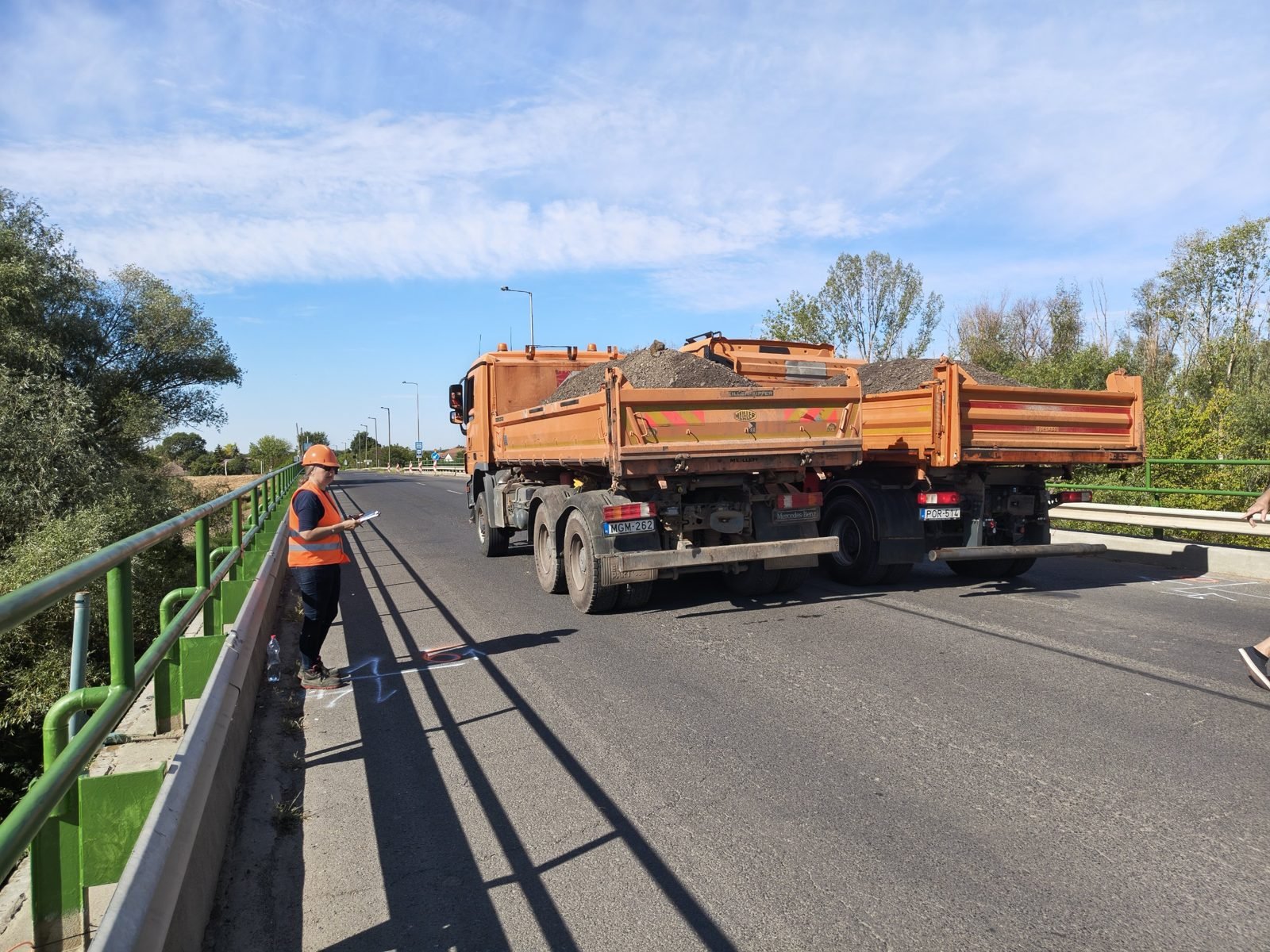
During loading: next to the positions marked with paint on the deck.
The measurements in numbers
- Körös bridges measured
- 3
- Bridges in the programme
- 5
- Measurements per day
- 300k
- Reliable battery runtime
- 14 hours
Five bridges, one programme
Magyar Közút verifies the load-bearing capacity of five large bridges across the Körös rivers by load testing. In September, three of them were measured: the bridges at Köröstarcsa, Körösladány and Kunszentmárton. These three girder bridges, built between 1975 and 1979, are part of main roads (44) and (47), while the other two, at Békés and Doboz, carry lower-order roads. All five bridges are specially managed bridges in the Unified Bridge Register (hidadatok.hu).
The three bridges measured in September have load class A / 1967 and a service load of 80/1986. The two bridges to be measured in October are somewhat newer: the Doboz Kettős-Körös bridge was built in 1982 and the Békés Kettős-Körös bridge in 1985. Both are five-span girder bridges with a structural length of 234.4 m and 213.5 m, load class A / 1979. The service load is 40/1993 for the Doboz bridge and 80/1986 for the Békés bridge (the latter has a 60 km/h speed limit). Both are managed by the Békés County Directorate and both are specially managed.
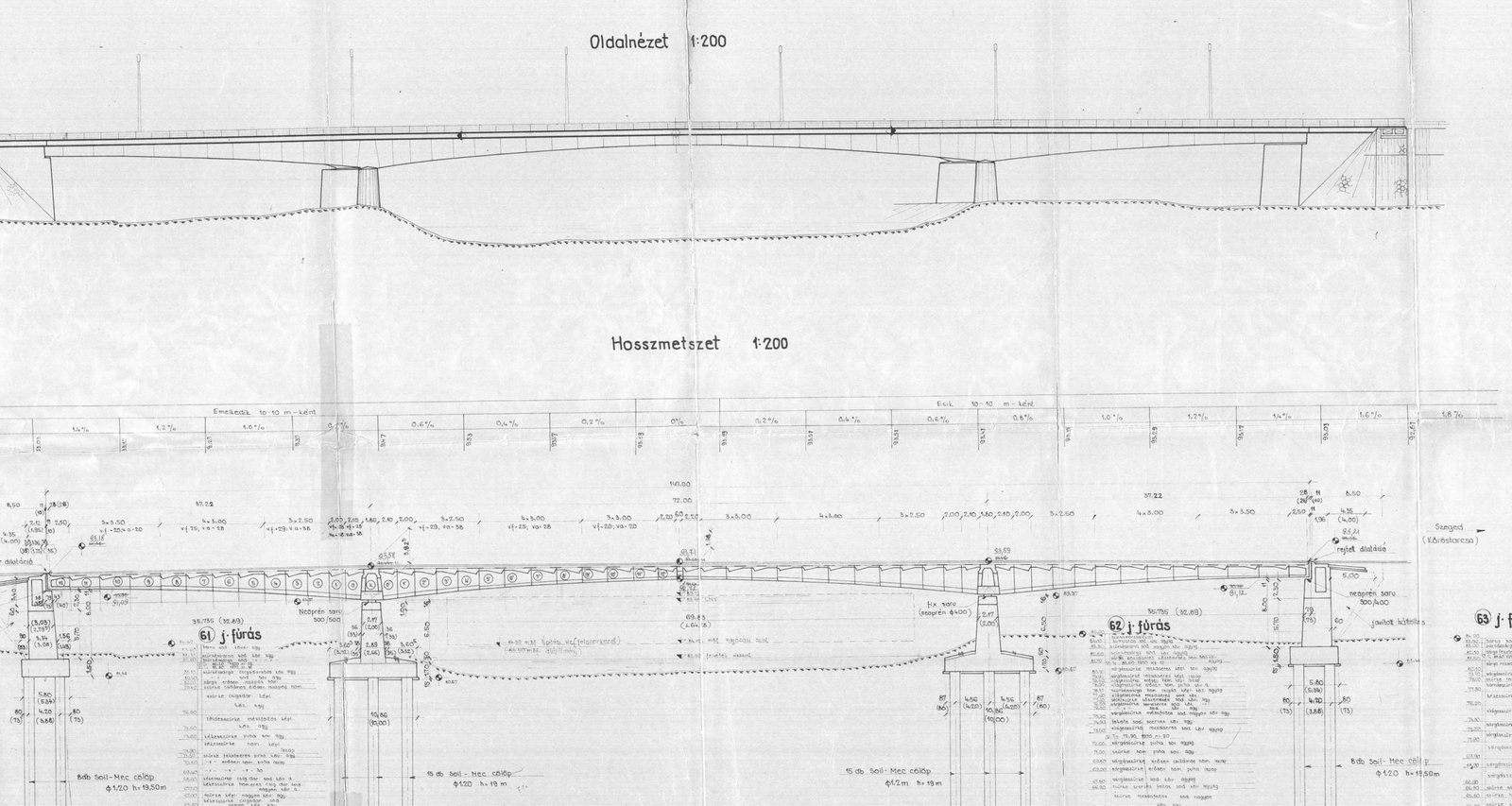
Side elevation and longitudinal section of the Sebes-Körös bridge at Körösladány (1:200): three spans, 147 m structural length. Source: ÚTIBER, 1977, general design.
The bridges measured in September
According to the register, the structural material of the spans is not identical. Source: hidadatok.hu, Unified Bridge Register.
- (47) 101+143
Köröstarcsa, Kettős-Körös bridge
Built in 1977. 4 spans, 172.1 m structural length, longest span 70 m. Minimum carriageway width 11.2 m, deck area 2101 m². Operated by the Békés County Directorate. Next principal inspection in 2033.
- (47) 91+794
Körösladány, Sebes-Körös bridge
Built in 1979. 3 spans, 147 m structural length, longest span 69.8 m. Minimum carriageway width 9 m, deck area 1786 m². Operated by the Békés County Directorate. Next principal inspection in 2029. Prestressed concrete, free cantilever assembly, skew 67°.
- (44) 50+316
Kunszentmárton, Hármas-Körös bridge
Built in 1975. 6 spans, 222 m structural length, longest span 70 m. Minimum carriageway width 11 m, deck area 2664 m². Operated by the Jász-Nagykun-Szolnok County Directorate. Next principal inspection in 2028. Technical monument.
The SURVIOT measurement system
The measuring task was to record the change in the distance (joint) between the precast segments during the load test, at several measuring points. We put together a single, easy-to-install measurement system that could be installed and removed simply on all three bridges.
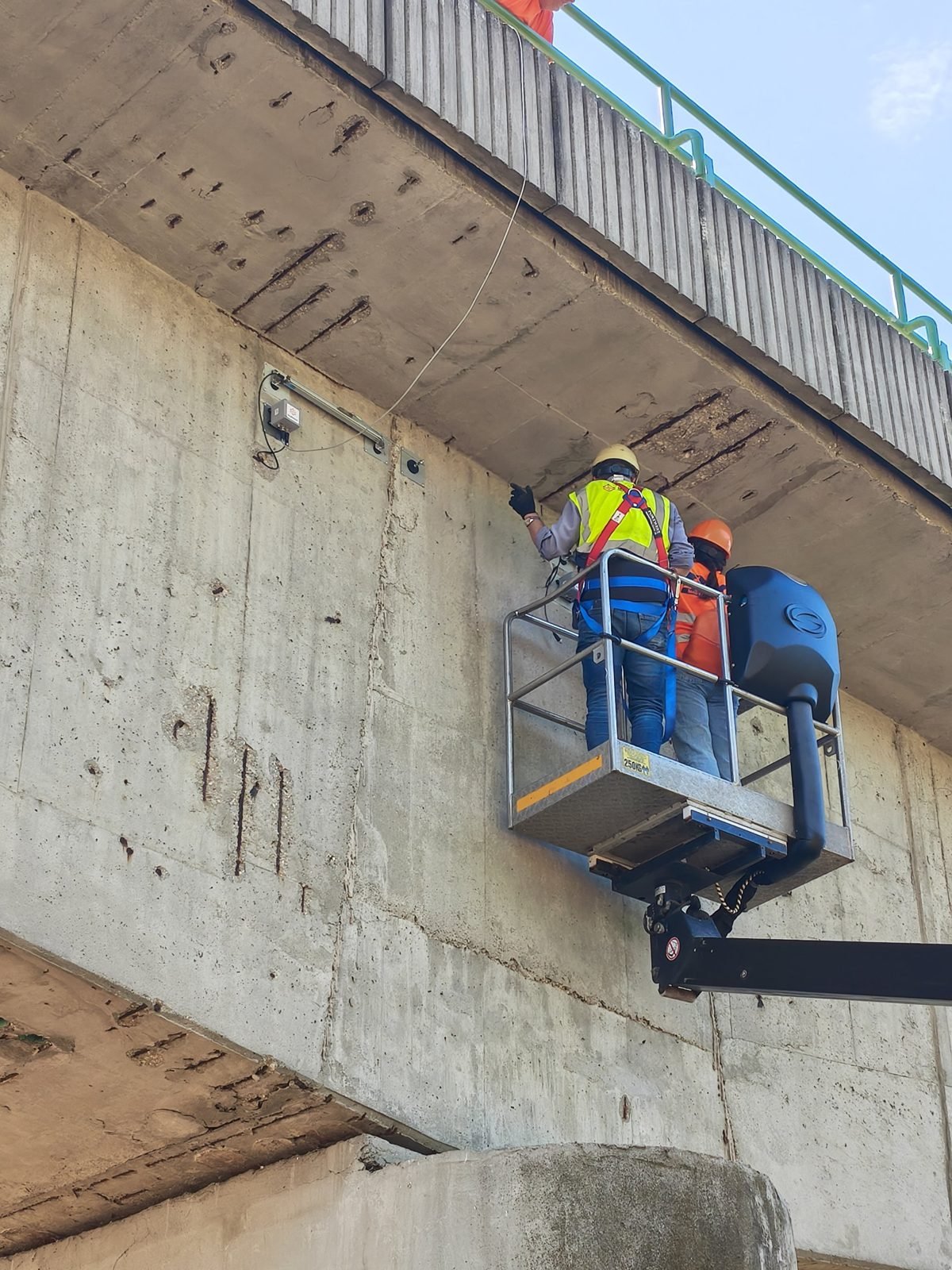
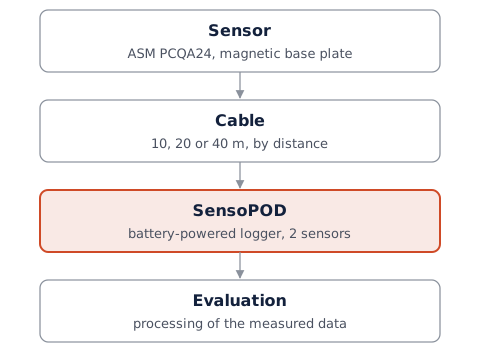
- Data logger: SURVIOT battery-powered SensoPOD, with two sensors per POD. One sensor sits right next to the POD on a prefabricated 1 m cable, the other at the distance given in the design, on a custom-made cable.
- Sensors: ASM PCQA24 displacement sensors, which Magyar Közút borrowed from the Budapest University of Technology and Economics and from HBM Méréstechnika Kft. We fixed base plates to the structure and placed the SensoPOD and the sensors on them with magnetic mounts, which allowed quick installation and removal.
- Cabling: a cable set sized for the spans: 3 × 40 m, 2 × 20 m and 5 × 10 m, plus 1–2 spare 10 m cables.
- Documentation: we handed over the documentation of the segment joint-opening measurement system to the client in August 2026, and kept the serial numbers and the bridge/position assignment in a checklist.
- Data volume: at Kunszentmárton about 300,000 measurement values were collected per day.
The sensor and the data logger on the side of the bridge structure, installed from the basket of the bridge inspection vehicle.
From the sensor to the evaluation
The signal of the sensors reaches the SensoPOD through the cable. The SensoPOD records the data for the whole duration of the measurement and the processing is done from these data.
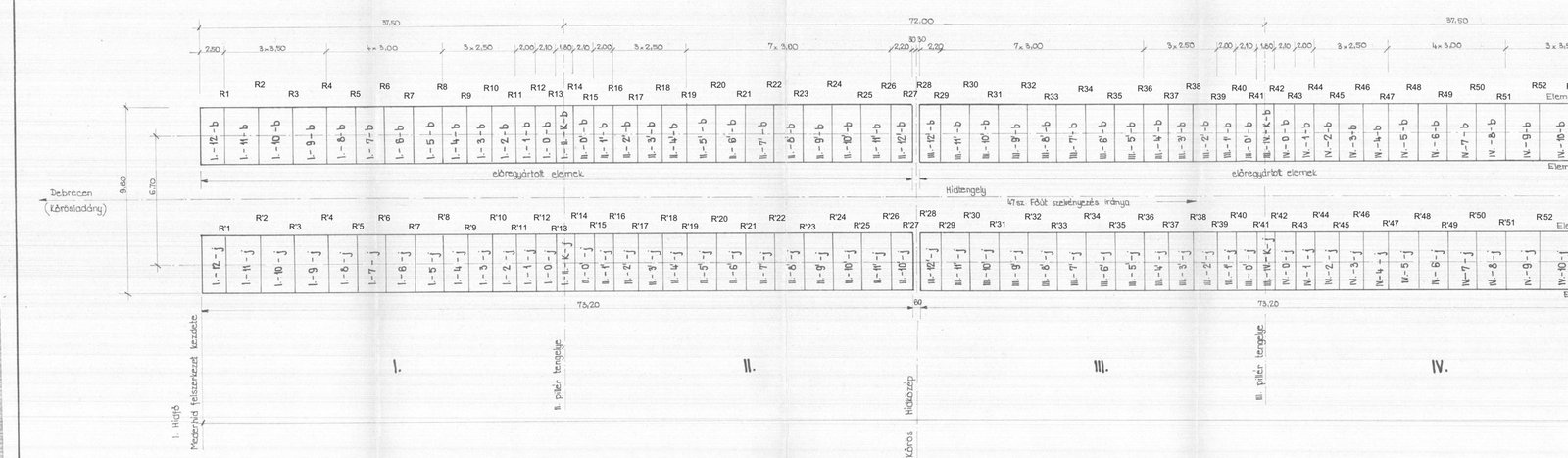
Precast elements and joints
Precast elements and the marking of the joints on the Kettős-Körös bridge at Köröstarcsa (R1–R54, on the other box R′1–R′54). Source: ÚTIBER, 1976, C-7.15.
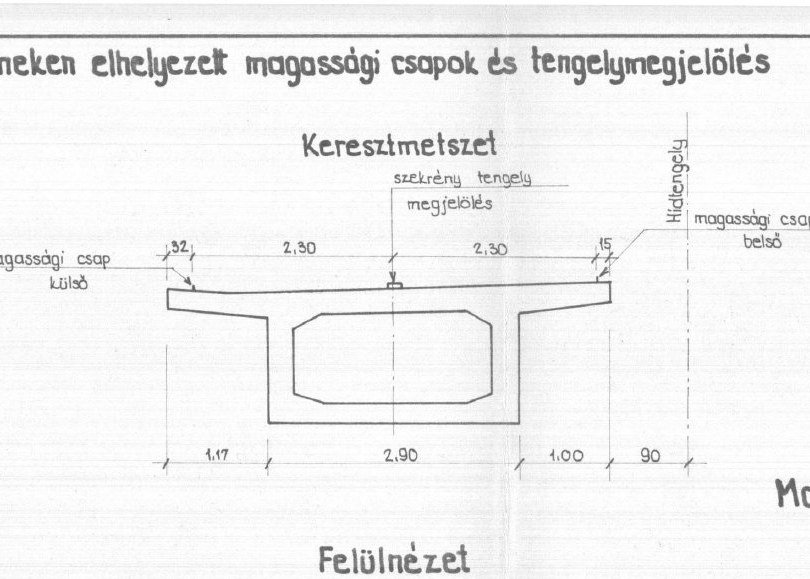
Cross-section of the bridge
Cross-section of the box girder with the position of the level and axis marker pins. Source: ÚTIBER, 1976, C-5.14.
How the three load tests went
We followed the same scenario at all three sites: installation and zero measurement on the previous day, load test on the measurement day, then removal. The second and third sites made use of the lessons of the first. In the words of Magyar Közút, by the second occasion the team worked together “almost brilliantly”.
Köröstarcsa, Kettős-Körös bridge
The site of the first installation. On 1 September at 10:00 we installed the sensors and the data loggers and fixed the cables, but did not connect them to the loggers yet (the measurement starts automatically after connection). On the measurement day, 2 September, at 7:00 we walked the bridge with the bridge inspection vehicle and connected the sensors to the loggers. At 8:00 the surveyor and the bridge engineers of Békés County arrived, marked the geodetic points and the load positions with paint, then carried out the levelling zero measurement. The truck convoy started at 9:00. After the load test, in the early afternoon, the system was dismantled and moved on to Körösladány.
Körösladány, Sebes-Körös bridge
The measurement system came here after the first bridge was dismantled. By 4 September Magyar Közút reported that the load tests at Köröstarcsa and Körösladány had both been completed successfully.
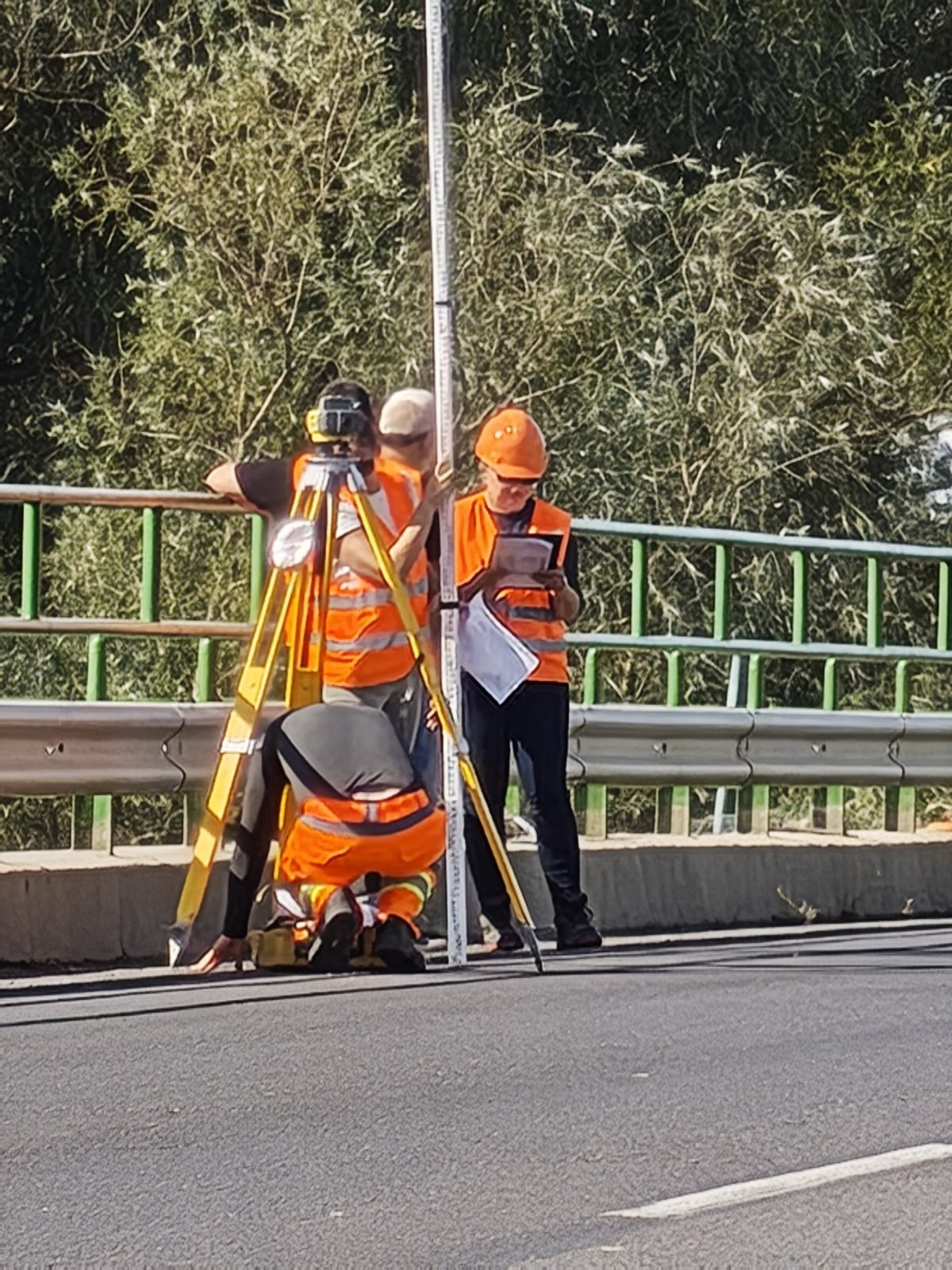
Geodetic zero measurement: level and staff on the bridge deck.
Kunszentmárton, Hármas-Körös bridge
The largest, six-span bridge required a two-day measurement, with one carriageway closed first and then periodic full closures.
- Tuesday 8 September, from 10:00: single-side closure, sensor installation with the bridge inspection vehicle, geodetic marks, load positions, zero measurement.
- 8 September, 14:00–14:30: connection of the sensors and the loggers, measurement continued through the night.
- Wednesday 9 September, 8:00: briefing.
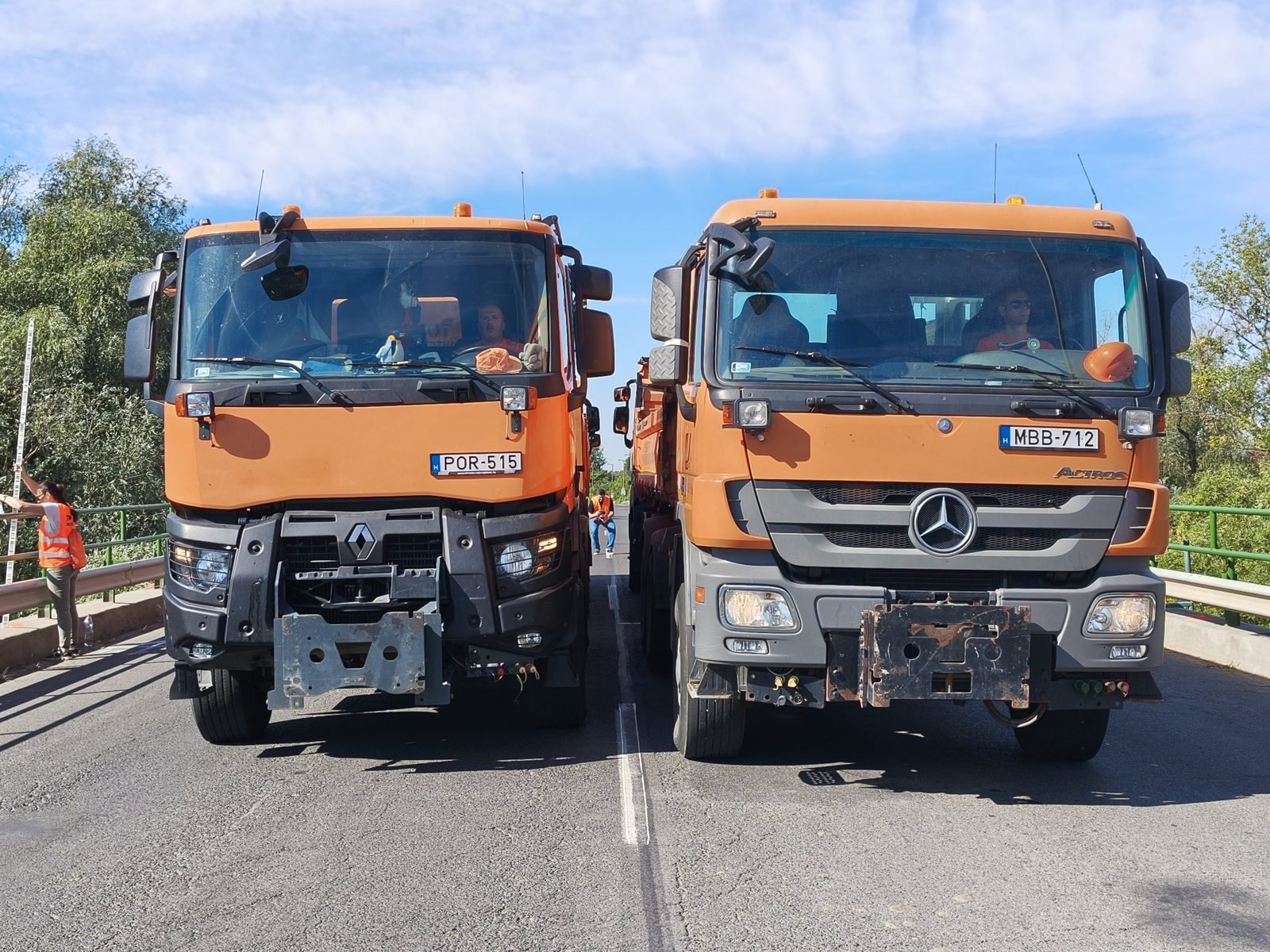
- 9 September, from 8:30: start of the load test: 7 static and 2 dynamic load cases with 4 weighed trucks, with periodic full closures.
- 9 September, 12:00–12:30: removal of the sensors.
The measurement was carried out by Magyar Közút, five colleagues from Szolnok took part in the traffic management, and the team kept in touch with 10–14 radios. The battery voltage was about 4 V at installation and about 3 V at removal. During the measurement the SensoPODs began to record faulty values, so the Kunszentmárton measurement had to be repeated.
The weighed trucks in the marked load positions.
Two difficulties, two development directions
The measurements brought two difficulties that are worth mentioning.
Battery runtime
Instead of the expected 24 hours, the reliable runtime was about 14 hours, and in cool weather it is advisable not to exceed even 12 hours of continuous operation.
Following the instructions
This is especially important, since missing even one step can ruin a whole series of measurements.
Development directions
A short, step-by-step, possibly video installation guide. The LED already signals a lot, and we will add a display of the battery charge level. The aim of the developments is that these errors cannot occur in the next measurements.
Results and outlook
The Kunszentmárton measurement had to be repeated because of the battery runtime. The measurement system supported the installation and removal of the sensors on all three bridges in a way that let the Bridge Department of Magyar Közút use the same scenario each time. The communications department of Magyar Közút filmed the Kunszentmárton measurement with a drone, and when sharing the video, Magyar Közút wrote: “we can be proud of it.”
The next step is the bridges at Békés and Doboz: the measurements will take place in the third week of October 2026.
Sources:
- hidadatok.hu bridge register data,
- communications of SURVIOT and Magyar Közút, June–October 2026.
Planning a project like this?
Ask for an introduction of SURVIOT and a free consulting session with our experts.